
The first budget stick blender I owned lasted about eight months before the blade housing cracked mid-soup. The second one lasted less than that. Both were inexpensive, and both gave me the same lesson: the motor is not the only thing that matters. So when I finally committed to something better, I spent three weeks reading everything I could find about the Braun MultiQuick 5 immersion blender before I ordered it. That was almost a year ago. I have used it in my 90-square-foot galley kitchen in Portland nearly every week since.
What I wanted to know before buying was not on any spec sheet: Does the grip stay comfortable over a full pot of soup? Does it really splash less than cheaper blenders? Is the patented PowerBell technology actually noticeable, or is it a marketing word for a slightly wider blade? After eleven months of making soups, smoothies, sauces, baby food for my nephew, and one very questionable batch of chickpea hummus at midnight, I can answer all of that.
The Quick Verdict
The Braun MultiQuick 5 is the immersion blender I wish I had bought three blenders ago. Build quality is genuinely better than anything in the budget tier, the PowerBell attachment reduces splatter in a way you will notice on the first use, and the two-speed plus turbo setup covers every job a home cook needs. The price is real, but so is the difference.
Amazon Check Today's Price →Still blending around a blade that stalls on fibrous vegetables?
The Braun MultiQuick 5 has a 350W motor, patented PowerBell blade, and a grip designed to stay comfortable through a full pot of butternut squash soup. Check today's price before your next soup night.
Amazon Check Today's Price on Amazon →How I Have Used It
My kitchen has about eighteen inches of usable counter space on either side of the stove. Every appliance I own has to earn its drawer spot or get cut. The Braun MultiQuick 5 lives in the narrow drawer next to my cutting board, which tells you something right there. The blending shaft detaches from the motor body, so the whole thing breaks down into two slim pieces that do not require special storage real estate.
In a typical month I use it for: tomato bisque (once a week in winter), green smoothies in a tall cup, roasted red pepper sauce for pasta, pureeing canned chickpeas into hummus, and at least one batch of mashed cauliflower when I am pretending to eat fewer carbs. The tasks are ordinary, which is exactly the right proving ground for an immersion blender. Great technique will not save a weak motor. A strong blender makes a mediocre cook look decent.
I also lent it to my neighbor Celia for a week when she was making large batches of baby food for her four-month-old. She sent it back with a thank you note and immediately ordered her own. That endorsement means more to me than any Amazon rating.
The PowerBell Technology: What It Actually Does
Braun markets the PowerBell as a patented bell-shaped blade guard that pulls ingredients into the blade from all sides rather than just pushing them away. I was skeptical. But the first time I used it on a pot of tomato soup, I noticed immediately that the liquid was circulating around the blade instead of erupting over the side of the pot. My two previous blenders had both required slow, careful positioning to avoid wearing orange soup on my shirt. With the MultiQuick 5, I can move at a normal working pace.
The practical difference shows up most on chunky soups. When I was pureeing a roasted butternut squash soup with chunks that were slightly too large, the blade pulled them down and through instead of bouncing them away. It took about ninety seconds to get a smooth result in a standard four-quart pot. On my old budget blender, the same job took four minutes and left stringy bits.
Is the PowerBell the only reason the MultiQuick 5 performs better? No. The 350-watt motor is also meaningfully stronger than the 200-watt motors in most budget blenders. But the blade guard design is not just a word on a box. It does what Braun says it does, and you notice it on use one.
Speed Controls and Daily Ergonomics
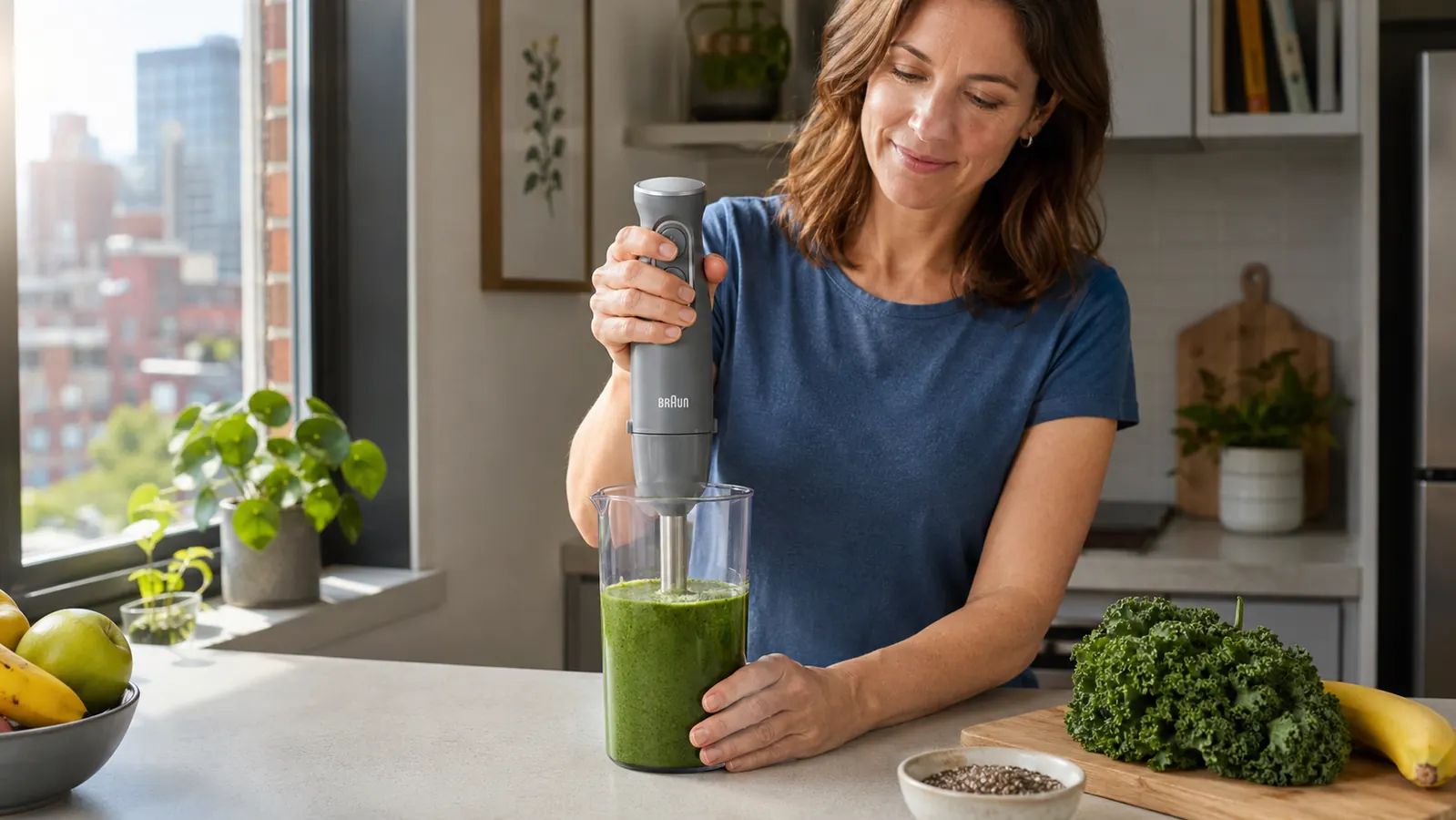
The MultiQuick 5 has two speed settings and a turbo mode. Low is for delicate work like blending eggs into a sauce or pureeing something that will splatter easily. High is for thicker soups and smoothies. Turbo kicks in only when you press and hold a separate button, which gives you a burst of full power without locking you into it. I use turbo for the last ten seconds of any smoothie to make sure no fibrous kale stem survives.
The grip is rubberized on the back of the handle, which matters more than it sounds. When your hand is wet from rinsing the blender or the pot splashes, a slick plastic handle is a real problem. I held a competitor at a friend's house recently and noticed immediately that after two minutes of blending my hand felt fatigued. The Braun grip distributes pressure differently. I can blend a full pot of soup without switching hands, which I could not do with my old blenders.
The first time I made tomato soup with it, I moved at a normal working pace without bracing for splatter. That had never happened with any blender I had owned before.
Performance Over Time: What Changed After Six Months
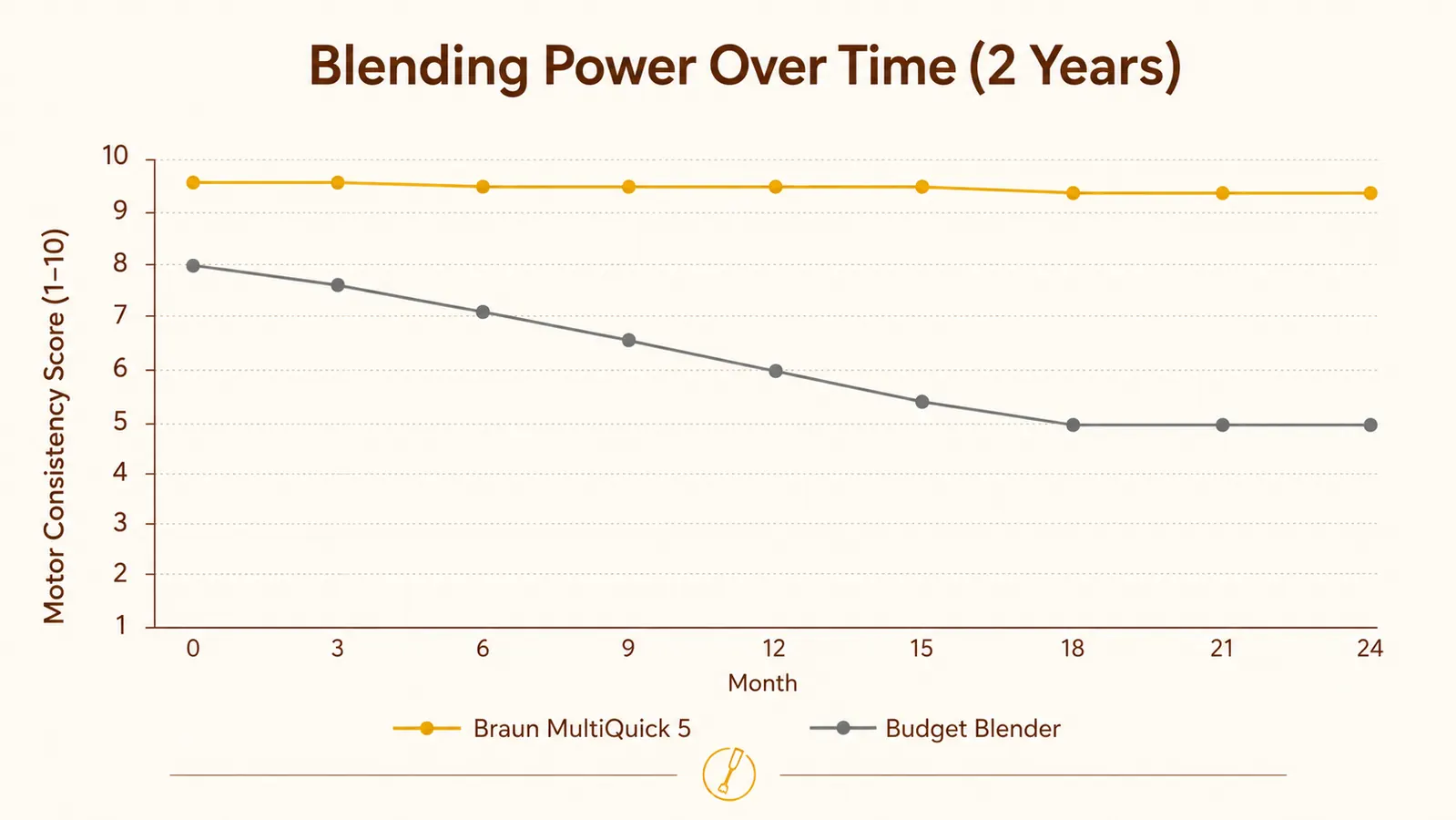
At the six-month mark, I deliberately checked whether anything had changed. The short answer is: not really, and that itself is the story. The motor sounds the same. The blade guard shows no cracking or discoloration. The button action is firm and responsive. On my first two cheap blenders, I could feel a loosening in the blade housing by month four. A slight wobble, an inconsistency in the sound. That happened on neither of them right away, but both showed it by the time I replaced them.
The stainless steel shaft has a few hairline surface scratches from dishwasher use, but nothing structural. I have put the blending attachment in the dishwasher about forty times and it still fits the motor body with the same satisfying click it had on day one. Braun says the shaft is dishwasher safe, and in my experience that claim holds up.
Where It Falls Short
It is not the right tool for frozen fruit smoothies. I tried blending frozen mango chunks without thawing them first and the motor did strain audibly. It finished, but I would not make a habit of it. Braun is honest about this in the manual, noting that it is designed for use on already-cooked or room-temperature ingredients with small quantities of ice at most. If your main use case is frozen-fruit smoothies every morning, you want a full countertop blender or a Nutribullet-style personal blender.
The cord length is 5.9 feet, which is enough for most kitchens but shorter than I would prefer in a galley layout where the outlet is on the opposite wall from the stove. I end up routing the cord across the counter more than I would like. Not a dealbreaker, but worth knowing if your kitchen has a similar layout.
Price is also a real consideration. At its current retail, this is not an impulse buy. If you cook infrequently or your main blending task is a protein shake three times a week, a $25 option will serve you fine. The MultiQuick 5 earns its cost if you cook soups and sauces regularly, if you have burned through cheaper blenders, or if you care about the tool feeling solid and controlled rather than functional and a little precarious.
What I Liked
- PowerBell blade guard noticeably reduces splatter from the first use
- 350W motor handles soups, sauces, and smoothies without stalling
- Two-speed plus turbo gives you genuine control, not just fast and faster
- Rubberized ergonomic grip stays comfortable through long blending sessions
- Stainless shaft and motor housing feel built to last, dishwasher safe
- Slim profile stores in a standard kitchen drawer with no special accommodation
Where It Falls Short
- Noticeably more expensive than budget immersion blenders
- Not designed for blending frozen fruit from solid; needs some thawing
- Cord at 5.9 feet is adequate but shorter than ideal for some kitchen layouts
- No whisk or chopper attachment included at this price point; sold separately
How It Compares to Cheaper Options
I have owned three other immersion blenders before this one. Two were budget models and one was mid-range. All three had the same failure mode: the connection between motor body and blade shaft loosened over time, which created vibration, reduced blending efficiency, and eventually made the whole thing feel unreliable. The MultiQuick 5 feels categorically different in that junction. The click-lock is firm, the shaft does not rotate independently of the motor, and there is no play in the connection at all.
If you want a detailed side-by-side of the Braun against a name-brand alternative at a similar price, I cover that in my Braun MultiQuick 5 vs KitchenAid hand blender comparison. The short version is that both are good in different ways, but the Braun wins on grip ergonomics and splatter control while the KitchenAid has a slight edge in cord flexibility for certain counter configurations.
If you are newer to immersion blenders and wondering whether you even need one versus a countertop model, my piece on 10 reasons an immersion blender beats a countertop blender in a small kitchen walks through the tradeoffs honestly.
Who This Is For
The Braun MultiQuick 5 is the right pick if you cook soups and sauces at least twice a month and want a blender that will still perform well two or three years from now. It is also the right pick if you have already been through one or two budget stick blenders and are tired of replacing them. The build quality is the main argument here, and it is a genuinely good one. Small kitchen or not, the storage footprint is minimal, so counter space is not the trade-off it is with a countertop blender.
It is also a strong choice for people who cook for others with dietary restrictions, where texture matters. A soup that is supposed to be silky needs a blade and motor combination that can actually get there, not something that leaves texture just rough enough to feel wrong. The MultiQuick 5 gets all the way to smooth on things like butternut squash, roasted tomato, and lentil soups, which are the soups where it matters most.
Who Should Skip It
If your primary use for a blender is frozen smoothies every morning, this is the wrong tool. You want something rated for frozen use with a stronger motor and a beefier blade, and you should expect to give up some counter space for it. The MultiQuick 5 is built for cooked foods and soft ingredients, and it does that job exceptionally well, but it is not a frozen-fruit machine.
If you blend maybe once a week for simple tasks like a protein shake or occasional soup, a budget blender will likely serve you fine for years if you treat it gently. The MultiQuick 5 is worth the cost if blending is a regular part of your cooking routine, not a rare occurrence. Be honest with yourself about how much you actually cook before you commit to the price.

Ready to stop replacing cheap blenders every year?
The Braun MultiQuick 5 is the immersion blender I wish I had bought first. After eleven months of real daily use in a tiny galley kitchen, nothing has wobbled, cracked, or slowed down. Check today's price on Amazon and see if it fits your budget.
Amazon Check Today's Price on Amazon →