
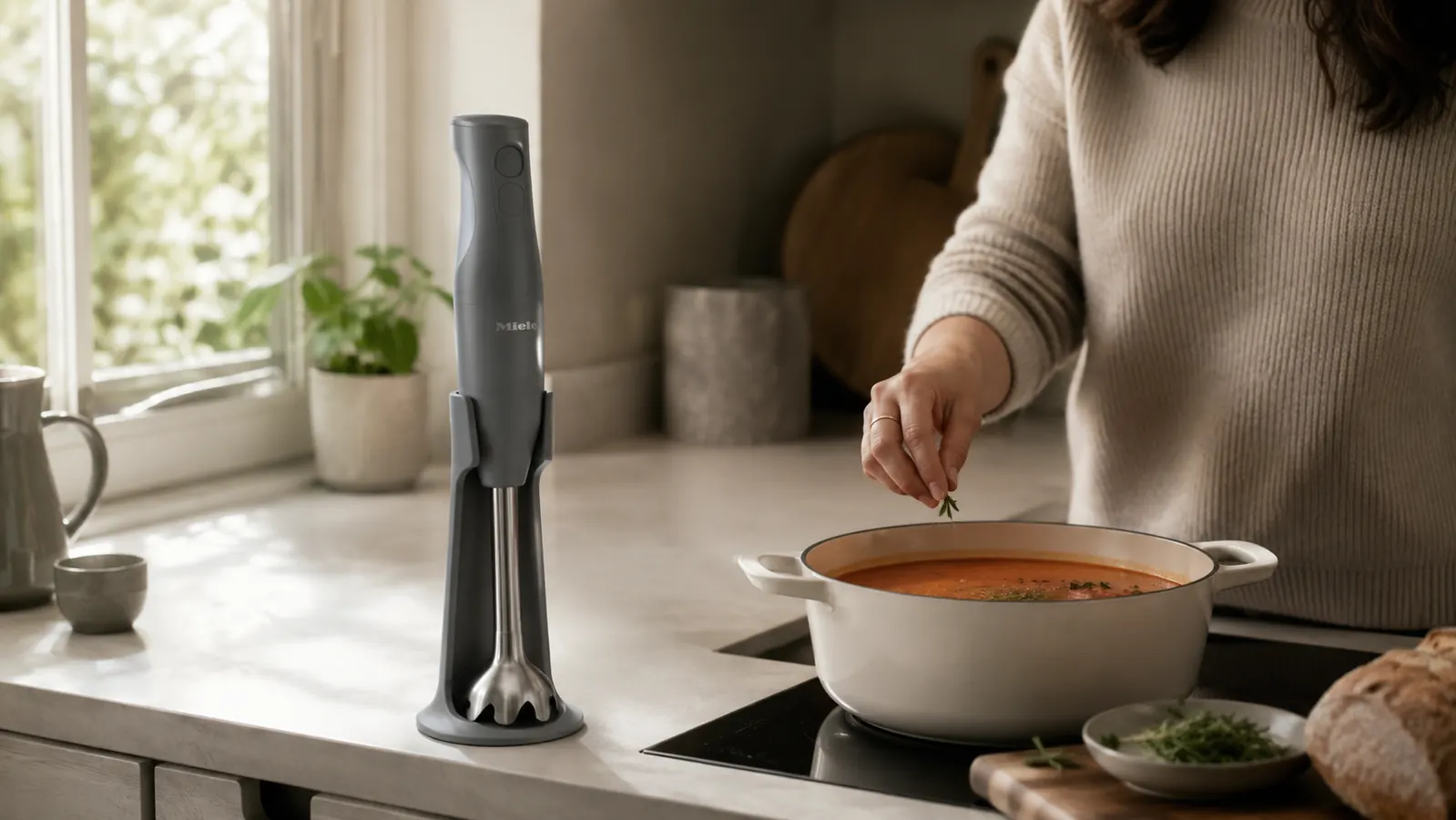
Let me tell you about the drawer in my galley kitchen. It is exactly fourteen inches wide and holds every long-handled tool I own. For three years, that drawer also held a budget immersion blender from a brand I will not name, and it did the job well enough that I never thought twice about upgrading. Then the plastic collar cracked mid-soup, I got a face full of tomato bisque, and I finally bought the Braun MultiQuick 5. That was seven months ago. I have tested it on everything from frozen fruit smoothies to butternut squash soup to hollandaise, and I have a lot of thoughts, some of them unflattering.
This is not the review that lists six features and tells you the Braun MultiQuick 5 is amazing. This is the review that tells you what the listing does not mention: the things that surprised me, the things that annoyed me, and the one situation where I genuinely wish I had bought something cheaper. If you are comparing this blender against a budget option and trying to decide if the price gap is real or just branding, keep reading.
The Quick Verdict
A genuinely better immersion blender for people who blend frequently, but the price gap only makes sense if you reach for it at least three times a week. Occasional blenders are better off with a budget alternative.
Amazon Check Today's Price →If you blend more than twice a week, the upgrade math works out in your favor.
The Braun MultiQuick 5 runs on 350 watts with Braun's patented PowerBell blade technology and a one-click detachable shaft for easy cleaning. Check what it is selling for right now before you decide.
Amazon Check Today's Price on Amazon →What Nobody Tells You Before You Buy
The Braun MultiQuick 5 has 4.6 stars and nearly 6,000 reviews on Amazon. Most of those reviews are positive, and they are not wrong. But there are four things I had to discover on my own, and I want to save you the same surprises I walked into.
First: the suction effect. When you press the blending bell flat against the bottom of a pot or bowl, the Braun creates a mild vacuum seal. When you lift quickly, the soup surges. Budget blenders have open bell guards that vent air constantly, so you can yank them out without drama. The Braun's PowerBell design is genuinely better at emulsifying, but it also seals more tightly against the bottom of your cookware. You need to tilt the head slightly before lifting, or you will learn the hard way. It took me two splattered shirts to figure this out. Tilt before you lift. I am practically putting that in neon because I wish someone had told me in week one.
Second: the cord is 5 feet long, and in my kitchen that just barely reaches the counter from the nearest outlet. If your outlet is behind the stove or mounted on the opposite wall, measure before you order. This blender is not cordless and there is no extended-cord version of the MultiQuick 5. That is not a dealbreaker for most people, but it is the kind of thing you want to know before the box arrives.
Third: the two-speed trigger is not what I expected. There is no dial, no numbered settings, no knob to twist. You press lightly for low speed, press harder for high speed, and press the separate turbo button with your thumb for a brief burst of maximum power. It sounds simple, and after a week it is simple. But the first few sessions I kept squeezing too hard and overshooting to high speed when I wanted low. You will probably do this too. Give yourself three or four uses before you judge the ergonomics, because they genuinely get better.
Fourth: the noise. The Braun MultiQuick 5 is noticeably louder than a cheap immersion blender, though still quieter than a full countertop blender. In a studio apartment or a dorm with thin walls, blending at 7am is an event. Not a crisis, but an event worth timing carefully if you have neighbors on the other side of your kitchen wall.

Where the PowerBell Technology Actually Makes a Difference
Braun's marketing talks a lot about the PowerBell blade system, and I was skeptical until I ran a side-by-side test with my old budget blender, which I kept around for exactly this comparison. I cooked the same batch of butternut squash soup, split it in half between two pots, and blended each with a different device. The cheap blender left visible fibrous threads through the soup at the two-minute mark. The Braun produced a completely smooth result in under a minute. Not marginally smoother. A genuinely different category of smooth.
The cheap blender left fibrous threads through the squash soup at the two-minute mark. The Braun produced a completely smooth result in under sixty seconds. Not marginally better. A different category.
The difference comes down to blade geometry. The PowerBell has three blades arranged around a recessed center point, so material is actively pulled into the cutting zone from multiple directions rather than being pushed around by two flat blades orbiting a central post. For anything fibrous, starchy, or thick, this architecture matters. For thin liquids like stock, citrus juice, or a basic vinaigrette, the difference is far less dramatic. The Braun earns its price on dense, chunky work. For quick dressings or light mixing jobs, a cheap blender handles it just fine.
I also ran it on frozen banana and a handful of frozen spinach to test smoothie performance. The Braun handled both without the brief motor stutter my old blender showed whenever it hit anything harder than a ripe banana. It is not an ice-crushing blender and Braun explicitly says not to use it that way, but light frozen fruit is well within its range. For a small-kitchen cook making a quick morning smoothie with fruit pulled straight from the freezer, this is a real practical win.

The One-Click Shaft: Small Feature, Bigger Impact Than You'd Expect
In three years with my cheap blender, cleaning the blending shaft was the part of the experience I disliked most. The blade was partially enclosed by the guard housing, and I had to swirl warm water carefully through the bell while trying not to nick my fingers on the exposed blade tip. The Braun solves this with one press of a release button on the handle body. The shaft pops off cleanly, you rinse it under the tap for ten seconds, and you snap it back on. The shaft and bell are also top-rack dishwasher safe if you prefer that.
I know that sounds like a minor quality-of-life note. It is not minor. The ease of cleanup is directly linked to how often you actually use the tool. When blending is fast to start and fast to clean up, you reach for the blender on a Tuesday night for a quick tomato sauce without thinking twice. When cleanup is a production, you reach for the potato masher and skip it. The one-click shaft is a meaningful part of why the Braun stays in my counter-tool rotation instead of migrating to the back of a cabinet like so many well-intentioned appliances before it.

Build Quality: What Holds Up and What I Am Watching
Seven months in, the Braun MultiQuick 5 looks and performs exactly as it did on the first day I used it. The rubberized grip zone has not peeled or degraded. The shaft locking mechanism has no wobble or play. The motor has not developed any new sounds or vibrations. That is a meaningful contrast to my previous blender, which developed a faint rattle around month four that turned into a notable grinding sensation by month six, just before the collar split.
The motor body is mostly hard plastic with a textured rubber grip inset along the handle. It does not feel cheap in the hand, but it is not a stainless-bodied or all-metal tool. The plastic feels denser and more deliberate than the budget alternatives, but I want to be clear about what it is. More importantly: in the one-star section of Amazon reviews, there is a pattern worth mentioning. A subset of heavy users report the turbo activation button failing after 12 to 18 months of daily use. I am at seven months and the button is completely fine, but the pattern exists and I think you deserve to know about it before you buy.
Braun offers a one-year warranty. Based on the failure pattern in the review data, problems that do occur tend to show up right around or after the 12-month mark. That is a meaningful gap in the coverage. If you are a daily heavy user, blending for a family four or five nights a week, I would look at the extended warranty options available through Amazon before you check out.
What I Liked
- PowerBell blade system produces noticeably smoother results on thick soups and purees than any budget alternative I have tested
- One-click shaft detachment makes cleanup genuinely fast and keeps fingers away from the blade
- 350 watts handles light frozen fruit and dense root vegetable purees without motor stutter
- Variable speed trigger feels natural and responsive after the first week of use
- Rubberized grip is comfortable to hold during longer blending sessions
- Blending shaft and bell guard are top-rack dishwasher safe
Where It Falls Short
- Sealed bell creates a suction effect that requires technique to avoid splashing, not obvious on first use
- 5-foot cord may not reach every small-kitchen outlet layout without an extension
- Noticeably louder than budget stick blenders, relevant in apartments with thin walls or shared spaces
- One-year warranty is shorter than some competitors at a similar price point
- Only two speed settings plus turbo, no numbered gradations for more precise control
- Price premium over budget blenders is hard to justify for infrequent cooks who blend once a week or less
How It Stacks Up Against the Alternatives You Are Probably Considering
The two alternatives that come up most when people are shopping in this price range are the KitchenAid corded hand blender and the Cuisinart Smart Stick. The KitchenAid is priced comparably to the Braun and has a more traditional cylindrical design, but the shaft does not detach for cleaning. You have to submerge the whole lower section and work around the blade. For a small-kitchen cook who makes soup once or twice a week, that cleaning reality compounds quickly. It is not a disqualifying flaw, but it is a real daily friction difference.
The Cuisinart Smart Stick costs noticeably less and does a credible job on thin to medium-bodied blending tasks. For smoothies made from soft ripe fruit and basic pasta sauces, it is a reasonable choice. Where it falls short is on anything with real density: a thick white bean dip, a roasted parsnip soup, a hummus base. The Braun MultiQuick 5 simply outperforms it on those tasks. The question you need to answer honestly for yourself is whether you cook those things on a regular basis. If the answer is yes, the price gap is justified. If the answer is occasionally, a cheaper blender probably serves you just fine.

Who This Is For
The Braun MultiQuick 5 is the right choice if you are cooking in a small kitchen and you use an immersion blender at least three times a week. That rhythm might look like: a pot of lentil soup on Monday, a green smoothie on Thursday, a tomato sauce on Saturday. At that frequency, the performance advantage over a budget blender shows up every single use, the cleanup convenience adds up quickly, and the higher upfront cost spreads thin over time. This is also a strong pick if you have already replaced a cheap blender once or twice and are tired of the replacement cycle.
It also earns its place if you cook for young kids who are in the textured-food-resistance phase of life. A blender that produces genuinely smooth results is a different tool from one that produces mostly-smooth results with occasional fibrous bits. If getting a toddler to eat butternut squash depends on there being zero visible threads in the bowl, the Braun solves that problem in a way a cheap blender simply cannot. For parents managing picky eaters in a small kitchen, that functional difference matters.
Who Should Skip It
Skip this blender if you use an immersion blender only once or twice a month. The performance improvement is real, but at low frequency the price premium does not return its value. A $25 blender that you replace every two to three years is the smarter financial move for occasional use. Also skip it if you need cordless convenience. The MultiQuick 5 is corded-only and Braun's cordless options are a separate, significantly more expensive product line.
Skip it if you expect to crush ice, process thick nut butter, or routinely blend hot liquids above 175 degrees Fahrenheit. The Braun is not rated for any of those tasks and the warranty does not cover motor damage from ice-crushing attempts. For ice-heavy work, a personal-sized countertop blender with a properly sealed lid is the right tool. And skip it if a 5-foot cord genuinely does not reach your kitchen outlet without a workaround, because an extension cord for a motor appliance sitting next to water is not a setup I would recommend to anyone.
Tired of replacing cheap blenders every couple of years? This one is built to last longer and blend smoother.
The Braun MultiQuick 5 is the immersion blender I recommend to any small-kitchen cook who reaches for one more than twice a week. The one-click shaft cleanup, 350-watt motor, and PowerBell blade make a meaningful real-world difference on soups, purees, and smoothies. See the current price and available color options on Amazon.
Amazon Check Today's Price on Amazon →